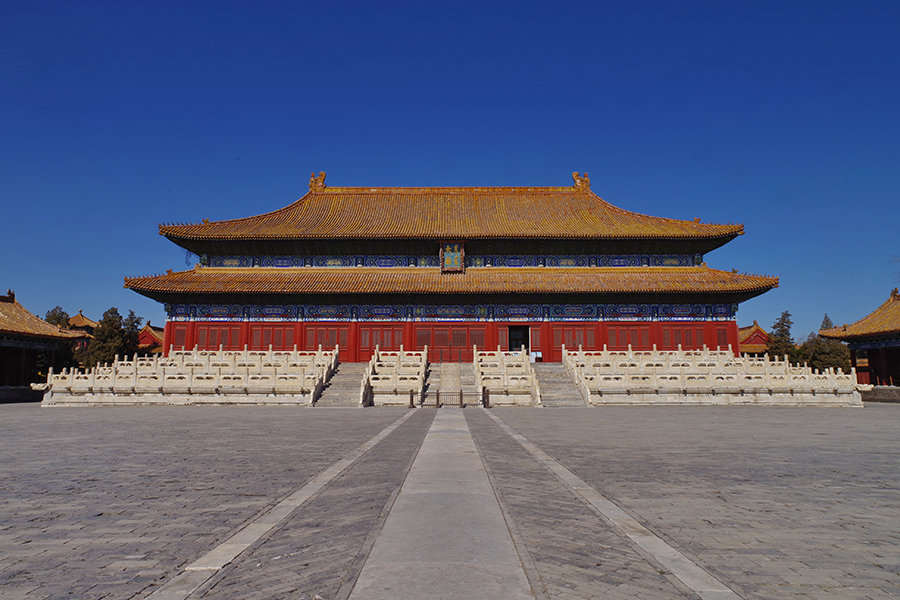
Beijing Working People's Cultural Palace
Introduction
The Beijing Working People's Cultural Palace, once known as the Ancestral Temple, is situated to the southeast of the Forbidden City. This historical site served as the venue for ancestral worship during the Ming (1368-1644) and Qing (1644-1911) dynasties, spanning from the early 15th to the early 20th century. The palace is a quintessential example of Chinese architecture, with its style closely resembling that of the Forbidden City. Covering an area of 197,000 square meters, the Cultural Palace stands as a testament to the grandeur of China's imperial past.
Historical Background
The Ancestral Temple, now the Beijing Working People's Cultural Palace, played a significant role in the cultural practices of the Ming and Qing dynasties. Enclosed by triple layers of vermillion walls, the temple's centerpiece consists of three regal halls aligned along a central axis. These halls are set on three tiers of white-marble terraces, each adorned with a yellow-glazed hip roof. This particular color and roofing style were exclusive to China's imperial family, highlighting the site's historical significance. The Hall of Sacrifice (Xiang dian), the front hall of the temple, was designated for sacrificial ceremonies, underscoring its spiritual importance in Chinese culture.
Architectural Significance
The architectural design of the Beijing Working People's Cultural Palace showcases the grandeur and meticulous craftsmanship characteristic of traditional Chinese architecture. The use of yellow-glazed roofs symbolizes imperial status, while the symmetrical layout reflects the aesthetic principles of balance and harmony. The palace's architecture not only embodies the cultural ethos of the time but also serves as a historical record of the architectural advancements achieved during the Ming and Qing dynasties.
Cultural Importance
The palace is an integral part of Beijing's cultural landscape, attracting both tourists and scholars interested in exploring China's rich history. It is strategically located along Beijing's north-south central axis, or zhongzhouxian, which is renowned for its historical and cultural significance. This axis, described by Chinese architect Liang Sicheng as the "backbone of Beijing's urban spatial structure", is lined with several historic buildings, including the Forbidden City, the Drum Towers and Bell Tower, and Jingshan Park. The axis serves as a cultural corridor that encapsulates the essence of Chinese cultural heritage.
Preservation and Modern Role
In 1949, following the founding of the People's Republic of China, the Ancestral Temple was transformed into the Beijing Working People's Cultural Palace. This transformation marked a shift in the site's function from a place of religious worship to a cultural and social hub for the working class. The palace now hosts various events and activities that promote cultural and artistic exchange. Efforts to preserve and restore the historical sites along the zhongzhouxian have been ongoing, ensuring that the palace continues to serve as a vital cultural landmark.
Beijing Working People's Cultural Palace Today
Today, the Beijing Working People's Cultural Palace continues to be a focal point for cultural activities and artistic exhibitions. It serves as a venue for various events, including art exhibitions like "Deutschland 8: German Art in China", which showcases contemporary German art. Such exhibitions provide a platform for cross-cultural dialogue and artistic expression, highlighting the palace's role in fostering international cultural exchange.








